
Brass Jewelry Manufacturing for Fashion Collections
A fashion drop is a fixed date with a movable product, and brass is often the material that makes the date. At a 100-piece minimum per design, a 25–30 day sample window and 3–4 weeks of production, a single design takes 48–60 days from approved concept to carton. That is the number a collection calendar has to absorb before a trend stops being one.
Key takeaways
- One brass design needs 48–60 days end to end, so a drop date has to be set at least two months ahead.
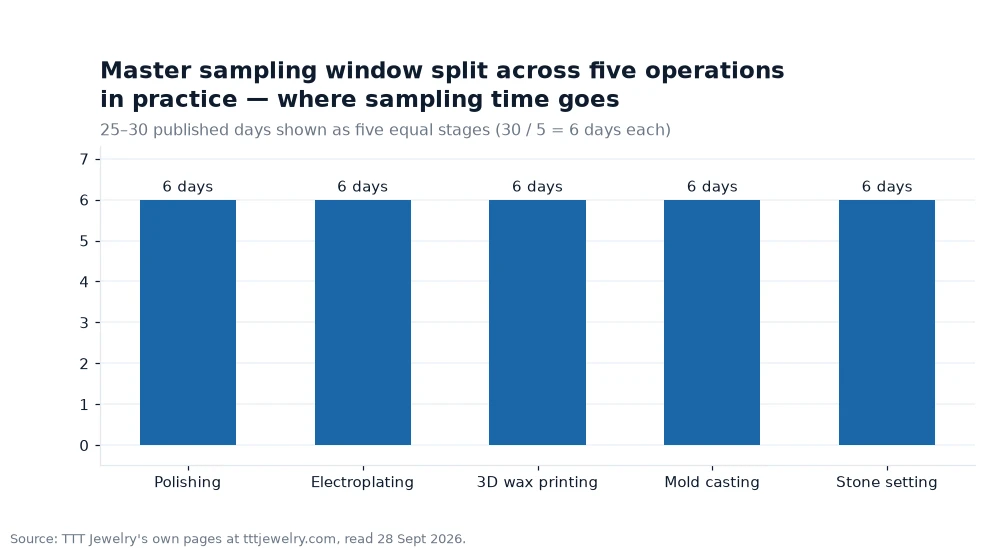
- The 25–30 day sample window splits into five operations, roughly 5–6 days each.
- Each design carries its own mould and its own 100-piece minimum.
- Private label keeps the factory's geometry; the brand supplies the finish, logo and packaging.
The calendar, not the factory, sets the deadline
Fashion collections are built backwards from a launch date. The date is fixed by a lookbook shoot, a wholesale market week or a retail reset, and everything upstream has to fit inside it. Brass is useful in that situation because the tooling is cut rather than cast in a permanent die, and a design can move from CAD to a physical sample inside a defined window instead of waiting on a seasonal tooling programme.
That window is still weeks, not days. A buyer who sees a trend in the market and wants it on a shelf has to work back through production, sampling and CAD. The arithmetic is unforgiving: 48–60 days for one design, plus transit, plus the buyer's own photography and listing time. A trend that arrives with eight weeks of life left is already too late for a new mould.
The practical response is to split the collection. Core shapes are developed ahead of the season and held as approved tooling; trend pieces are added late at low depth. That way the calendar carries one sampling round for the new pieces instead of a full development cycle for the entire range.
What private label means in brass
Private label and custom brass jewelry are not the same arrangement, and the difference decides how much of the calendar the brand controls. In private label the brand adopts an existing geometry and applies its own finish, logo, hallmark and packaging. In OEM the brand supplies the CAD and owns the design outright. In ODM the factory develops the concept with the brand and keeps the resulting collection exclusive to it.
For a fashion drop, private label is the fast route because the geometry already exists and the sample is a finishing exercise rather than a development one. The brand still chooses among 14K, 18K and 24K gold or rhodium, still specifies anti-tarnish e-coating, and still sets the laser engraving and the packaging. What it does not do is wait for a new mould.
The trade-off is differentiation. A shape available to other brands is not a signature shape, and the 100% NDA that covers original development does not apply to a stock geometry in the same way. Brands that plan to build an identifiable line usually move to developed designs after the first season, once the drop calendar has proved which shapes sell.
The sample window has five internal stages
The published 25–30 days is a container for five operations: 3D wax printing, precision mould casting, stone setting, polishing and custom electroplating. The order is fixed for a piece with stones, because the setting has to be cut into a cast form and the surface finish comes after the setting tools have been put away.
Read as a budget, the window gives roughly 5–6 days per operation: 25/5 = 5 days at the fast end and 30/5 = 6 days at the slow end. That is an average rather than a schedule, but it is a useful one, because it shows how little room a single rework consumes. A setting correction that takes three days pushes every later operation, and plating cannot start until polishing is signed off.
The five stages also explain why a sample can look finished and still be a week away. A piece that has been cast and set looks like jewelry on the bench, but it has not been polished or plated, and those two operations are what the buyer actually judges. A private label brass jewelry programme shortens this block by starting from an approved geometry, but it does not remove polishing or plating from it.
| Operation | Brand decides | Days at 25 | Days at 30 |
|---|---|---|---|
| 3D wax printing | Approve CAD proportions | 5 | 6 |
| Mould casting | Accept the alloy and weight | 5 | 6 |
| Stone setting | Stone size and placement | 5 | 6 |
| Polishing | Gloss level per surface | 5 | 6 |
| Custom electroplating | Colour and topcoat | 5 | 6 |
The days column is a planning average, not a published breakdown; the manufacturer publishes the window as a whole. It is included because a fashion buyer needs to know where a delay lands. A problem found at casting resets the remaining four stages, while a problem found at plating resets only the last one.
Where the trend decision meets the MOQ
The published minimum for artisan eco-brass is 100 pieces per design. For a fashion collection that figure sets the exposure on every experimental shape: ten trend pieces at 100 units is 1,000 pieces, and each of those pieces carries its own mould and its own sample approval.
Sixty days of development is therefore not the only constraint. A drop built from many new shapes multiplies the sampling queue even when the shapes are simple. The usual compromise is a small number of new moulds supported by existing geometries in new finishes, so the trend reads in the colour and the styling rather than in a completely new form.
Depth also matters for the reorder. A shape that sells out at 100 pieces can be rerun without new tooling, and that rerun is where a fashion brand recovers the sampling time it spent. A shape that sells 40 pieces leaves 60 in stock and no reason to reorder, which is the expensive outcome at the minimum quantity.
Worked example
Set a drop date and work backwards. From approved concept the chain runs 2 days of CAD, 25–30 days of sampling and 21–28 days of production, which totals 48–60 days.
If the drop date is fixed, the concept has to be approved 60 days before the carton is needed, and that assumes the fast end of nothing. Add a second sample round and the requirement becomes 2 + 25 to 30 + 25 to 30 + 21 to 28 = 73 to 90 days, or roughly eleven to thirteen weeks. A collection with four new shapes sampled in parallel still needs the same 48–60 days, provided the tooling is cut at the same time and the sample bench can hold four pieces.
The internal split gives a second check. Five operations across 25–30 days is 5–6 days each, so a single rework that costs six days consumes one whole operation of slack. A buyer who asks for a change after plating has used the last of the window and should expect the full block to repeat.
Frequently asked questions
How far ahead should a fashion drop be planned?
At least 60 days from approved concept to carton for one design, and 73–90 days if a second sample round is likely.
Can a private label order skip sampling?
It can start from an existing geometry, but polishing and plating still have to be proved on a physical piece before the 100-piece run begins.
Is a separate mould needed for every shape?
Every new shape needs a dedicated tool, so the 100-piece threshold applies separately to each one in the drop.
Building a drop that survives its own deadline
A collection calendar works when the number of new shapes is treated as the scarce resource and the unit count as the flexible one. Fewer moulds, deeper runs and a wider use of finish variations keep the sampling block to a single pass.
Brands that expect to repeat a shape across seasons should look at the custom jewelry wholesale structure, where approved tooling shortens the next order to production and packing. It also helps to read the factory's own TTT Jewelry pages before the first brief, because the material and timing figures there are the same ones a collection plan has to be built on.
Source note: figures come from the manufacturer's own website (tttjewelry.com), read 28 Sept 2026.[1]