
The problems that damage a car or air-care launch are usually decided before production starts, which is why they are difficult to fix with better manufacturing. Six mistakes account for most of them: assuming the category is unregulated, assuming the fragrance is the main cost, copying a longevity claim, testing on a desk instead of in a vehicle, choosing packaging before the release mechanism, and leaving concentration decisions until after the format is fixed. Each one is avoidable with a decision made a few weeks earlier, and each one costs far more to correct once packaging has been ordered.
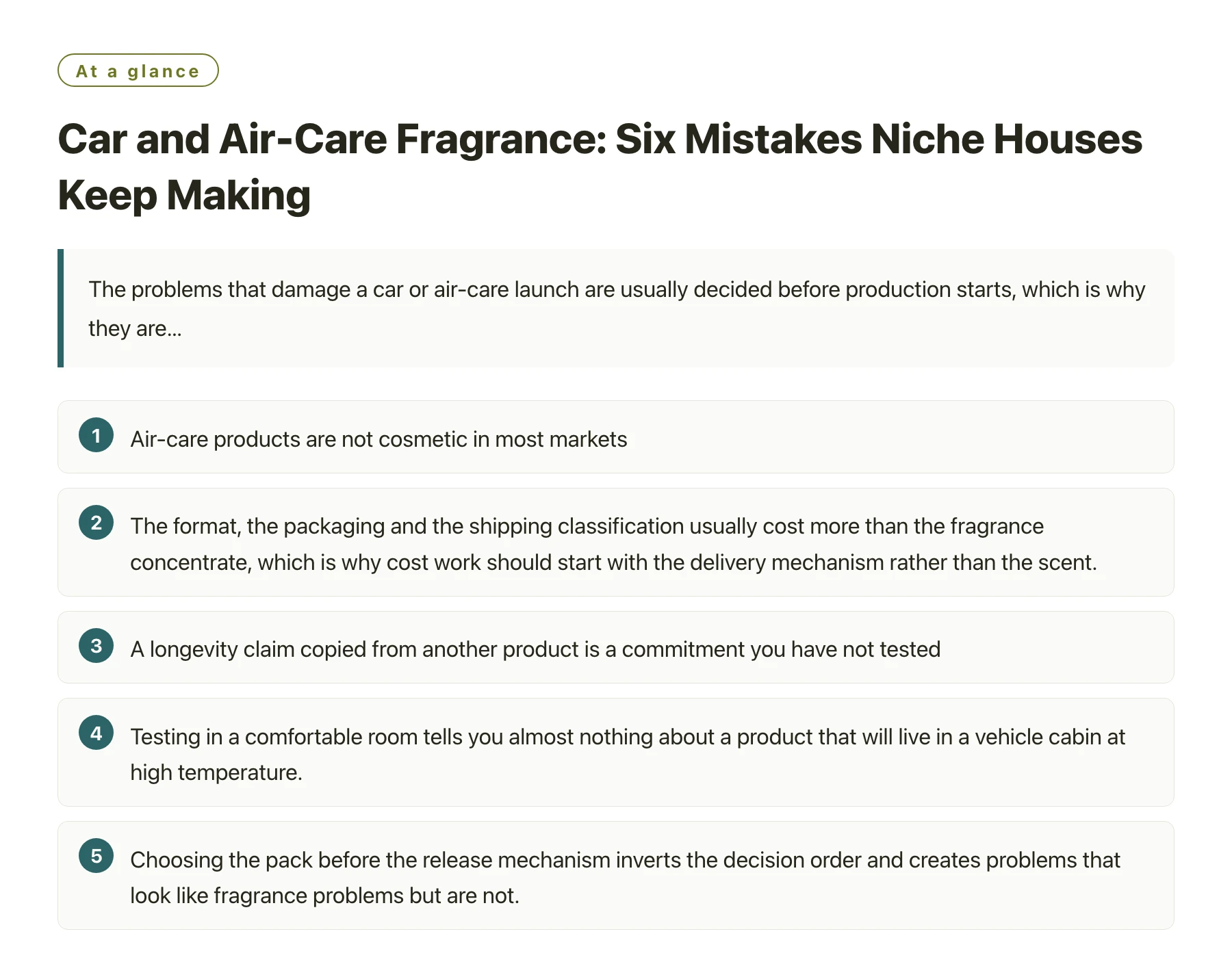
Key takeawaysAir-care products are not cosmetic in most markets, but they are still subject to labelling and product safety obligations, so the absence of a cosmetic assessment is not the absence of rules. · The format, the packaging and the shipping classification usually cost more than the fragrance concentrate, which is why cost work should start with the delivery mechanism rather than the scent. · A longevity claim copied from another product is a commitment you have not tested, and it is the claim customers complain about most often. · Testing in a comfortable room tells you almost nothing about a product that will live in a vehicle cabin at high temperature. · Choosing the pack before the release mechanism inverts the decision order and creates problems that look like fragrance problems but are not. · Concentration and format are one decision in this category, because the release mechanism determines how much fragrance can usefully be present.
Niche houses tend to enter car and air-care with better creative instincts than mass-market brands and less category experience. The result is a pattern of avoidable problems that repeat across launches, in roughly the same order each time. Recognising them early is worth more than any amount of reformulation later.
This is written from the perspective of a brand doing this for the first time or the second time, where the goal is to ship a distinctive product without paying for discoveries that other people have already made. It is deliberately blunt about the mistakes, because the cost of each one is real and arrives at the least convenient moment.
Six mistakes that survive the first review
None of these are exotic. All six show up in products that look well designed and well briefed, and all six are visible in the specification before anything is manufactured.
Treating air care as if it needed no labelling discipline
Because a room spray or a vent clip is generally not a cosmetic, founders sometimes conclude that nothing applies to it. What actually changes is which framework applies, not whether one does. Cosmetic rules and product safety rules are different instruments with different expectations, and the labelling obligations follow the market where the product is sold rather than the market where it was made. [1]
Different markets also phrase their requirements differently, which matters if the same product ships to more than one country. Comparing the labelling guidance published by a second regulator is a quick way to see which parts of your artwork are market-specific. [2] The practical fix is simple: name the responsible party for labelling in the specification and give them the intended market list.
Assuming the fragrance is the expensive part
In fine fragrance, the concentrate is often the largest element of cost. In car and air-care it frequently is not, because the delivery mechanism, the component set and the packaging carry more of the total. A team that optimises the fragrance first may be negotiating over a small share of the cost while the real money sits in an oversized closure or an unnecessary secondary pack.
The correction is to build the cost model format-first: mechanism, components, assembly, packaging, then fragrance load. It also changes which cost conversations are worth having, because a cheaper version of a carrier can free budget for the concentrate.
Copying a longevity claim from another product
A claim such as a number of weeks of use is a commitment, and it is measured rather than assumed. Release rate depends on surface area, temperature, airflow and how the customer uses the product, so a claim that is accurate for one format is not transferable to another. Copying it is the fastest route to the complaint that matters most, because longevity is what customers judge the product on.
If a claim is important to the marketing, test it in the conditions the product will meet and build in a margin. If it cannot be tested before launch, soften the claim rather than gamble on it.
Testing on a desk instead of in a vehicle
Room temperature evaluation is convenient and misleading. A car interior in summer is a hostile environment for a product made of plastic, adhesive, fragrance and solvent, and failures appear in the components first. Independent laboratory testing can cover the physical and stability questions, and commissioning it early is cheaper than diagnosing a field failure. [3]
If the product is a vent clip, test it on a vent. If it is a hanging card, test it with the airflow and temperature a vehicle actually produces. The specification should say what the test conditions were, so a later version can be compared against the same reference.
Choosing the pack before the release mechanism
A designer selects a beautiful small bottle, and only then does anyone ask how the fragrance will escape it. At that point the options are limited to whatever fits the bottle, which is the reverse of a workable sequence. The release mechanism determines fill volume, wick or pad geometry, seal requirements and in some cases the orientation the unit must be stored in.
The way to avoid this is to write the release mechanism into the design brief as a constraint, exactly as one would write in a maximum dimension. Designers work well with constraints; they work badly with corrections discovered at tooling.
Leaving concentration until after the format is fixed
Concentration and format are effectively one decision. A diffuser and a spray can carry the same fragrance direction at very different loads, and the load affects intensity, life, cost and even the stability of the carrier. Understanding how fragrance concentration changes performance before the format is frozen prevents a later discovery that the chosen format cannot deliver the profile the brand wanted.
This is also where a niche house's creative ambition can outrun the physics of the format. The honest response is to adjust the format or the profile rather than to increase the load past the point where the product behaves well.
Why these mistakes cost more for a niche house
A large brand absorbs a format mistake across many products and many markets. A niche house feels it in the margin of a single range, and often in the reviews, because the customers who buy from a small brand are buying the promise of care as much as the scent. A leaking clip or a claim that does not hold damages something that a price reduction cannot repair.
The mitigation is procedural rather than expensive. Freeze the format and the release mechanism together, write the intended use and the market list into the specification, test under realistic conditions, and treat the cost model as format-first. None of that requires a bigger team; it requires the decisions to happen in a sensible order.
It is also worth asking what the partner's experience actually covers. A supplier who mainly fills fine fragrance may be excellent at the scent and unfamiliar with the mechanics of an air-care range, in which case the specification has to carry more of the load. If the scope of fragrance manufacturing services in China includes component sourcing and assembly as well as filling, the format decisions can be taken with the people who will build the product.
Before committing, it is fair to ask what the partner has learned from Xuelei in previous projects. A supplier with relevant experience will answer with specifics about heat, leakage or pad drying rather than with general assurances. The details of the programme behind www.xuelei.com are a reasonable reference point for the kind of questions worth asking, whether or not that is the partner you choose.
Sources
- European Commission: Cosmetics in the EU —— The European Commission's overview of EU cosmetics rules, including the responsible person, product information file and safety report requirements.
- Health Canada: Cosmetic Safety —— Health Canada's cosmetics pages, covering cosmetic notification, the ingredient hotlist and safety requirements for cosmetics sold in Canada.
- SGS: Cosmetics, Personal Care & Household Testing —— Testing, inspection and certification services for cosmetics and personal care, including microbiological, stability and safety testing aligned with cosmetics GMP.
Frequently asked questions
Is car fragrance a regulated product?
It is regulated, but usually not as a cosmetic. The framework that applies depends on the market and on the intended use, and it typically covers product safety, labelling and the classification of the fragrance or solvent for transport. The practical implication is that you still need a named party responsible for labelling rather than no compliance work at all.
Why does my car fragrance lose its scent so quickly?
The release mechanism is usually the cause rather than the fragrance. Vent clips can dry unevenly, hanging cards can be sealed too well by their sleeve, and diffuser wicks can be undersized. Before changing the formula, check how the product releases and under what temperature and airflow conditions.
How do I make a longevity claim responsibly?
Measure it in conditions the product will actually meet, then present a claim with a margin rather than the best figure observed. Longevity depends on surface area, temperature and customer behaviour, so a claim carried over from a different format is not evidence of anything.
What should be decided first, the packaging or the format?
The format, because it determines the release mechanism, the fill volume and the seal requirements. Packaging should be designed against those constraints rather than the other way round. Reversing the order usually produces a beautiful object that cannot deliver the fragrance reliably.
Do I need third-party testing for a small air-care range?
Not necessarily for everything, but physical and stability testing under realistic conditions is cheap insurance against a field failure. Prioritise the tests that address the failure modes of your chosen format, such as leakage, heat behaviour and component compatibility.